SR-71 Blackbird Military Skin Faceplate Scale
Carry the Blackbird
On March 6, 1990, the Air Force retired the SR-71 Blackbird program. Pilot Lt. Col. Ed Yeilding and RSO Lt. Col. Joseph Vida were assigned to fly tail number 61-7972 from Los Angeles to the Smithsonian in Washington, D.C. Nobody asked them to set records on the way. They set four, including LA to DC in 64 minutes and 20 seconds. The aircraft that spent its career being classified went out at full speed, on its own terms.
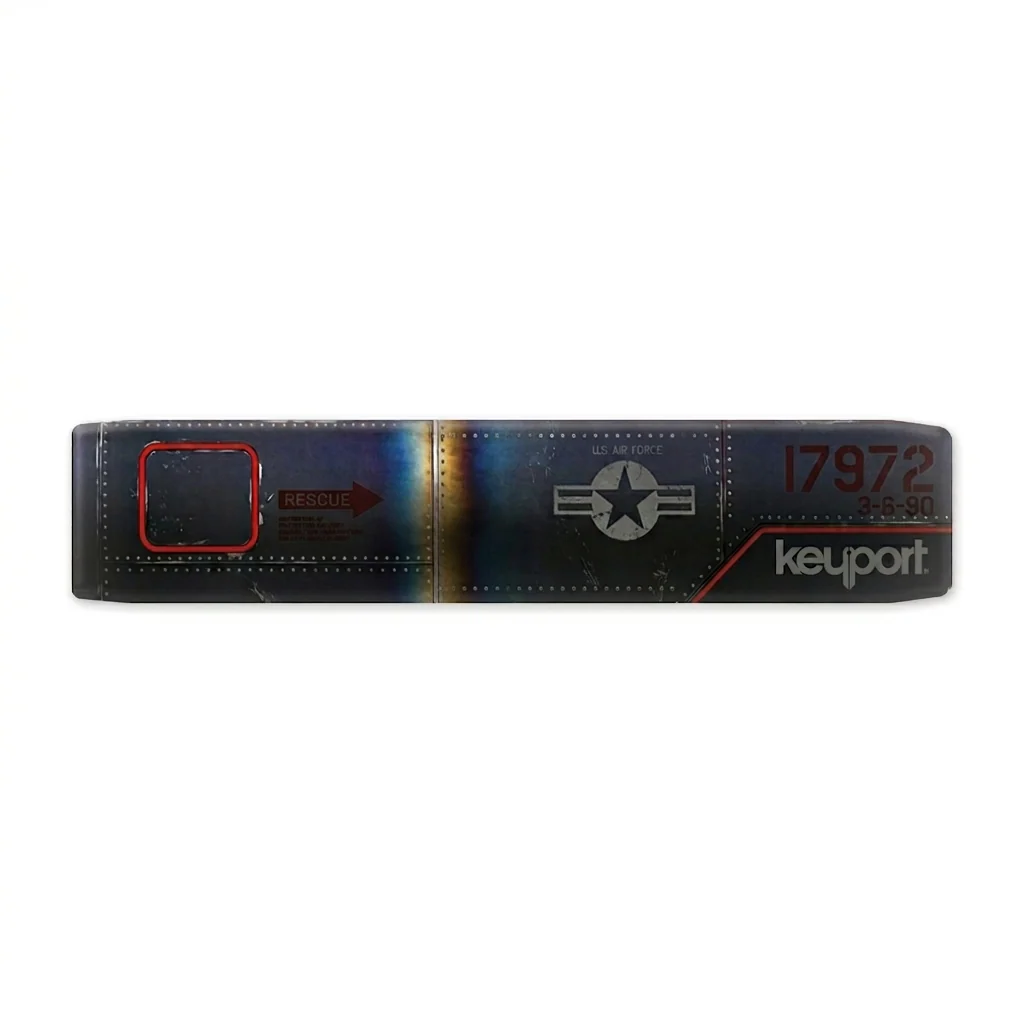
This faceplate recreates a section of 61-7972's fuselage skin: the radar-absorbing coating over titanium alloy that made the Blackbird invisible at Mach 3.3. The dark red markings, rescue panel outlines, and subdued USAF roundel are authentic to the aircraft. Panel fastener rows trace the seams where titanium sheets joined and expanded from friction heating. The heat discoloration along one seam shows the gold-bronze-blue oxidation colors that titanium develops above 500°F.
Look closely at the lower right: "17972" and "3-6-90." The tail number and the date of the final flight. Some machines don't retire quietly.
Part of the Military Skins series. Each faceplate simulates the exterior surface of an iconic military vehicle, reduced to fit your Keyport.
About the SR-71 Blackbird
The Lockheed SR-71 Blackbird was the fastest air-breathing aircraft ever built. Developed by Kelly Johnson's Skunk Works team and flown by the U.S. Air Force from 1964 to 1998, the SR-71 conducted strategic reconnaissance at altitudes above 80,000 feet and sustained speeds over Mach 3.2. At cruise, it outran every interceptor and every missile ever launched against it. Over more than 3,500 operational sorties, no Blackbird was lost to enemy fire.
The aircraft was 93% titanium by weight, built to survive skin temperatures over 600°F caused by friction with the atmosphere at sustained Mach 3. The titanium expanded so significantly in flight that the fuselage panels had to be designed loose on the ground; the aircraft only sealed itself shut once heated to operating temperature. Fuel leaked from the seams on the tarmac. JP-7, the specialized fuel developed for the program, was so stable it could not be ignited by a dropped match.
Only 32 SR-71s were ever built. Twelve were lost to accidents. The remaining airframes are now distributed across museums in the United States and the United Kingdom. Tail #61-7972, the aircraft depicted on this faceplate, is on permanent display at the Smithsonian National Air and Space Museum's Steven F. Udvar-Hazy Center in Chantilly, Virginia, the final resting place of the airframe that set four world speed records on its way there.
What is a Faceplate Scale?
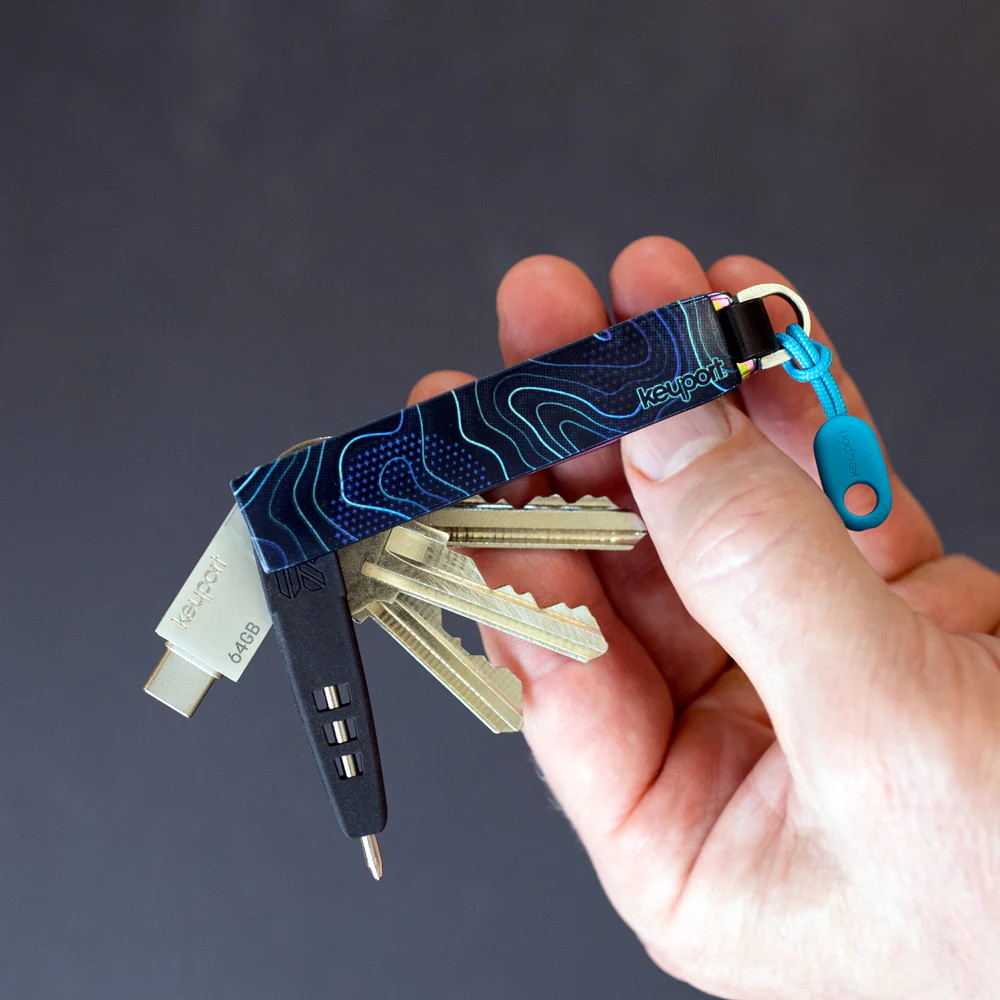
Keyport Faceplate Scales are removable side plates that allow you to customize your Keyport Pivot, Keyport Slide, or Anywhere Tools Bundles by Keyport. Similar to knife scales, Faceplate Scales add both function and personalization to Keyport's modular key organizers, key holders, and keychain multi-tools.
Why Choose a Faceplate Scale?
The SR-71 Faceplate Scale features a durable stainless spring steel plate staked to a polycarbonate outer shell. The graphics are hardened on the outside of the PC shell with a special ink that is baked on with ultraviolet light and highly resistant to wear and tear. The UV-hardened ink preserves the authentic weathering, oxidation, and panel markings of the original aircraft skin, even with daily carry. The fastener-free design makes snapping on a new Faceplate a literal snap, and removing them is very easy with the help of a paper clip, pen tip, or Module Removal Tool (MRT). So, you can switch them up whenever you like.
Note: Each Faceplate Scale is individually sold.
Key Features
- Precision Fit - Designed to seamlessly attach to the Keyport Pivot, Anywhere Pocket Clip (as a money clip), NEBA Module, MOCA2 Module, Keyport Slide 3.0, or the Keyport Slide 4.0.
- Ergonomic & Lightweight – Adds style without bulk, maintaining a sleek, compact profile.
- No-Fastener Attachment – Securely clicks on/off with no screws or extra hardware.
- Built to Last – Features stainless steel backing and UV-hardened graphics for maximum durability.
- Multi-Use Functionality – Works as a money clip when paired with the Anywhere Pocket Clip.
Specifications
- Materials: Stainless Steel & Polycarbonate
- Graphics: UV Hardened Ink
- Dimensions: L: 2.865" H: 0.596" T: 0.105"
- Weight: 0.18 oz.
Frequently Asked Questions
What is a Faceplate Scale?
Keyport Faceplate Scales are removable side plates for customizing your Keyport Pivot, Slide, and Anywhere Tools. They work like knife scales, offering both function and flair.
Are Faceplate Scales compatible with all Keyport products?
Faceplates are compatible with the Keyport Pivot, Slide 3.0, Slide 4.0, NEBA Module, MOCA2 Module, and the Anywhere Pocket Clip (where it functions as a money clip).
How do I remove or replace a Faceplate Scale?
A small tool is required to remove a Faceplate, either a paperclip, pen tip, or our recommended Keyport Module Removal Tool (MRT). To remove, simply depress the center dimple, slide the Faceplate backward, and lift it off.
The MRT is especially helpful for both Pivot setup and quick removal of modules or Faceplates.
▶️ Watch How-To Video at 1:25
Are Faceplates durable?
Absolutely. Each Faceplate Scale features a stainless steel backing and UV-hardened ink for long-lasting, scratch-resistant performance.
Can I buy more than one to change them up?
Yes. Our modular design means you can collect and swap Faceplates anytime to match your style, mood, or mission.
Description
Carry the Blackbird
On March 6, 1990, the Air Force retired the SR-71 Blackbird program. Pilot Lt. Col. Ed Yeilding and RSO Lt. Col. Joseph Vida were assigned to fly tail number 61-7972 from Los Angeles to the Smithsonian in Washington, D.C. Nobody asked them to set records on the way. They set four, including LA to DC in 64 minutes and 20 seconds. The aircraft that spent its career being classified went out at full speed, on its own terms.
This faceplate recreates a section of 61-7972's fuselage skin: the radar-absorbing coating over titanium alloy that made the Blackbird invisible at Mach 3.3. The dark red markings, rescue panel outlines, and subdued USAF roundel are authentic to the aircraft. Panel fastener rows trace the seams where titanium sheets joined and expanded from friction heating. The heat discoloration along one seam shows the gold-bronze-blue oxidation colors that titanium develops above 500°F.
Look closely at the lower right: "17972" and "3-6-90." The tail number and the date of the final flight. Some machines don't retire quietly.
Part of the Military Skins series. Each faceplate simulates the exterior surface of an iconic military vehicle, reduced to fit your Keyport.
About the SR-71 Blackbird
The Lockheed SR-71 Blackbird was the fastest air-breathing aircraft ever built. Developed by Kelly Johnson's Skunk Works team and flown by the U.S. Air Force from 1964 to 1998, the SR-71 conducted strategic reconnaissance at altitudes above 80,000 feet and sustained speeds over Mach 3.2. At cruise, it outran every interceptor and every missile ever launched against it. Over more than 3,500 operational sorties, no Blackbird was lost to enemy fire.
The aircraft was 93% titanium by weight, built to survive skin temperatures over 600°F caused by friction with the atmosphere at sustained Mach 3. The titanium expanded so significantly in flight that the fuselage panels had to be designed loose on the ground; the aircraft only sealed itself shut once heated to operating temperature. Fuel leaked from the seams on the tarmac. JP-7, the specialized fuel developed for the program, was so stable it could not be ignited by a dropped match.
Only 32 SR-71s were ever built. Twelve were lost to accidents. The remaining airframes are now distributed across museums in the United States and the United Kingdom. Tail #61-7972, the aircraft depicted on this faceplate, is on permanent display at the Smithsonian National Air and Space Museum's Steven F. Udvar-Hazy Center in Chantilly, Virginia, the final resting place of the airframe that set four world speed records on its way there.
What is a Faceplate Scale?
Keyport Faceplate Scales are removable side plates that allow you to customize your Keyport Pivot, Keyport Slide, or Anywhere Tools Bundles by Keyport. Similar to knife scales, Faceplate Scales add both function and personalization to Keyport's modular key organizers, key holders, and keychain multi-tools.
Why Choose a Faceplate Scale?
The SR-71 Faceplate Scale features a durable stainless spring steel plate staked to a polycarbonate outer shell. The graphics are hardened on the outside of the PC shell with a special ink that is baked on with ultraviolet light and highly resistant to wear and tear. The UV-hardened ink preserves the authentic weathering, oxidation, and panel markings of the original aircraft skin, even with daily carry. The fastener-free design makes snapping on a new Faceplate a literal snap, and removing them is very easy with the help of a paper clip, pen tip, or Module Removal Tool (MRT). So, you can switch them up whenever you like.
Note: Each Faceplate Scale is individually sold.
Key Features
- Precision Fit - Designed to seamlessly attach to the Keyport Pivot, Anywhere Pocket Clip (as a money clip), NEBA Module, MOCA2 Module, Keyport Slide 3.0, or the Keyport Slide 4.0.
- Ergonomic & Lightweight – Adds style without bulk, maintaining a sleek, compact profile.
- No-Fastener Attachment – Securely clicks on/off with no screws or extra hardware.
- Built to Last – Features stainless steel backing and UV-hardened graphics for maximum durability.
- Multi-Use Functionality – Works as a money clip when paired with the Anywhere Pocket Clip.
Specifications
- Materials: Stainless Steel & Polycarbonate
- Graphics: UV Hardened Ink
- Dimensions: L: 2.865" H: 0.596" T: 0.105"
- Weight: 0.18 oz.
Frequently Asked Questions
What is a Faceplate Scale?
Keyport Faceplate Scales are removable side plates for customizing your Keyport Pivot, Slide, and Anywhere Tools. They work like knife scales, offering both function and flair.
Are Faceplate Scales compatible with all Keyport products?
Faceplates are compatible with the Keyport Pivot, Slide 3.0, Slide 4.0, NEBA Module, MOCA2 Module, and the Anywhere Pocket Clip (where it functions as a money clip).
How do I remove or replace a Faceplate Scale?
A small tool is required to remove a Faceplate, either a paperclip, pen tip, or our recommended Keyport Module Removal Tool (MRT). To remove, simply depress the center dimple, slide the Faceplate backward, and lift it off.
The MRT is especially helpful for both Pivot setup and quick removal of modules or Faceplates.
▶️ Watch How-To Video at 1:25
Are Faceplates durable?
Absolutely. Each Faceplate Scale features a stainless steel backing and UV-hardened ink for long-lasting, scratch-resistant performance.
Can I buy more than one to change them up?
Yes. Our modular design means you can collect and swap Faceplates anytime to match your style, mood, or mission.