Willys MB Jeep Military Skin Faceplate Scale
Carry the Workhorse
In 1940, the U.S. Army issued a specification most manufacturers thought was impossible: a four-wheel-drive reconnaissance vehicle under 1,300 pounds, with a 660-pound payload capacity, and a working prototype due in 49 days. Of 135 companies approached, two responded. Willys-Overland delivered the MB. By the end of the war, more than 647,000 had rolled off the line. Generals rode in them. Medics loaded stretchers across them. Signal corps ran wire from them. Ernie Pyle wrote from North Africa: "I don't think we could continue the war without the jeep. It does everything. It goes everywhere. It's as faithful as a dog, as strong as a mule, and as agile as a goat."
Eisenhower listed it among the handful of pieces of equipment senior officers regarded as most vital to victory in Africa and Europe. He noted the irony: none of them were designed for combat.
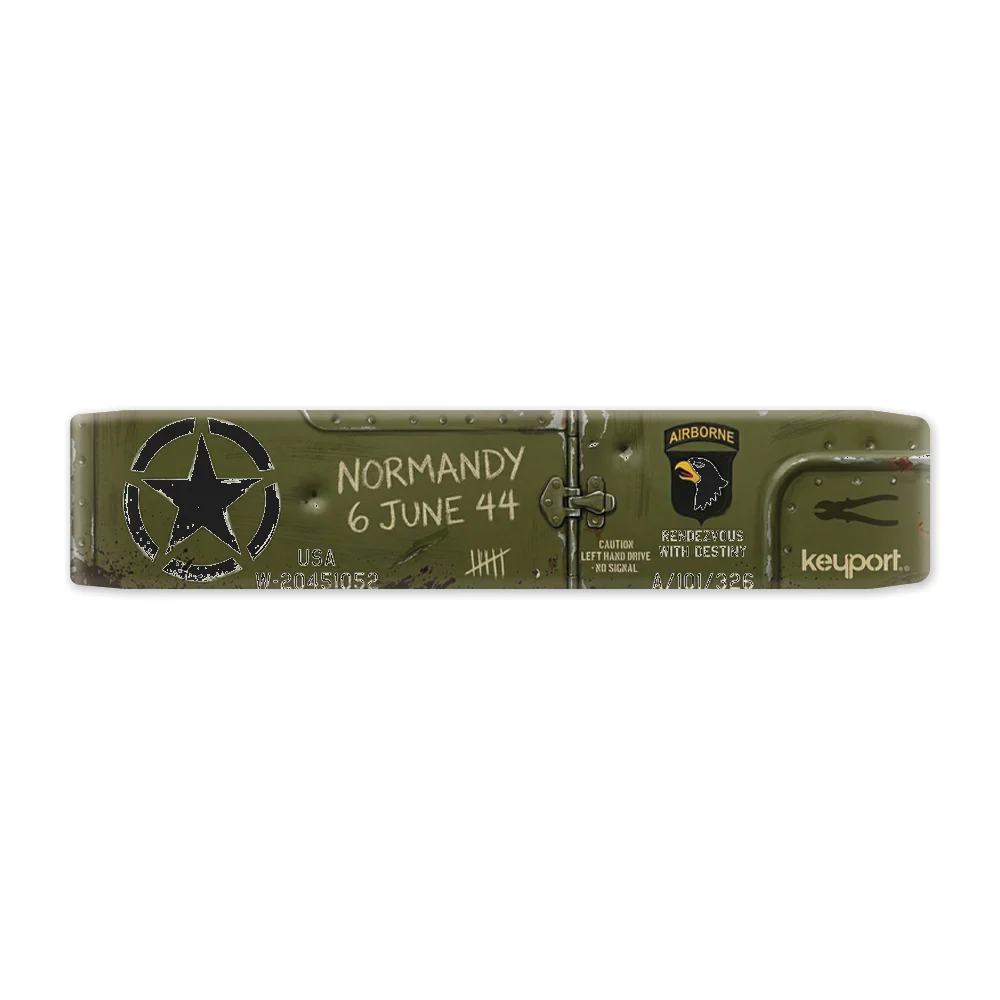
This faceplate recreates a section of a Willys MB attached to the 101st Airborne Division, Normandy, June 1944. The broken-circle invasion star marks an Allied vehicle in the D-Day theater. The hand-chalked "NORMANDY" and "6 JUNE 44" are the kind of markings soldiers scrawled on their vehicles every day. The Screaming Eagle insignia of the 101st and the division motto, "Rendezvous with Destiny," mark the unit. The small wire-cutter bar silhouette references the vertical bars welded to jeep bumpers to cut piano wire the Germans strung across roads at neck height. The mud is from the Norman bocage. The paint is worn to bare metal at every stress point. This vehicle has been working since Utah Beach and hasn't stopped.
No single jeep is famous. That's the point. The most important vehicle of the century was the one nobody noticed.
Part of the Military Skins series. Each faceplate simulates the exterior surface of an iconic military vehicle, reduced to fit your Keyport.
About the Willys MB Jeep
The Willys MB was the original Jeep. Designed in 1940 to meet U.S. Army specifications that 133 of 135 manufacturers refused even to bid on, the MB was a 60-horsepower, four-wheel-drive, 2,300-pound vehicle that could go almost anywhere and carry almost anything. American Bantam designed the first prototype. Ford had the production capacity. But Willys-Overland's "Go Devil" engine was decisive, and the Army standardized on the Willys design, licensing Ford to build a nearly identical version as the GPW. Parts were fully interchangeable between Willys and Ford jeeps. Between 1941 and 1945, Willys produced 362,841 MBs and Ford produced 280,448 GPWs.
The MB served in every theater of the war. It hauled wounded under fire, carried command staff across continents, towed antitank guns, and ran wire for the Signal Corps. It fit inside a C-47 and could be loaded into a glider for airborne assault. It carried twice what it was designed for and kept going. A Marine MB on Guadalcanal was struck by Japanese shrapnel and awarded the Purple Heart. General George Marshall called the jeep "America's greatest contribution to modern warfare."
After the war, soldiers came home wanting one. Willys-Overland began selling the CJ — Civilian Jeep — in 1945. Every Wrangler, Cherokee, and Gladiator on the road today traces directly to the 60-horsepower box on wheels that Willys built in 49 days.
What is a Faceplate Scale?
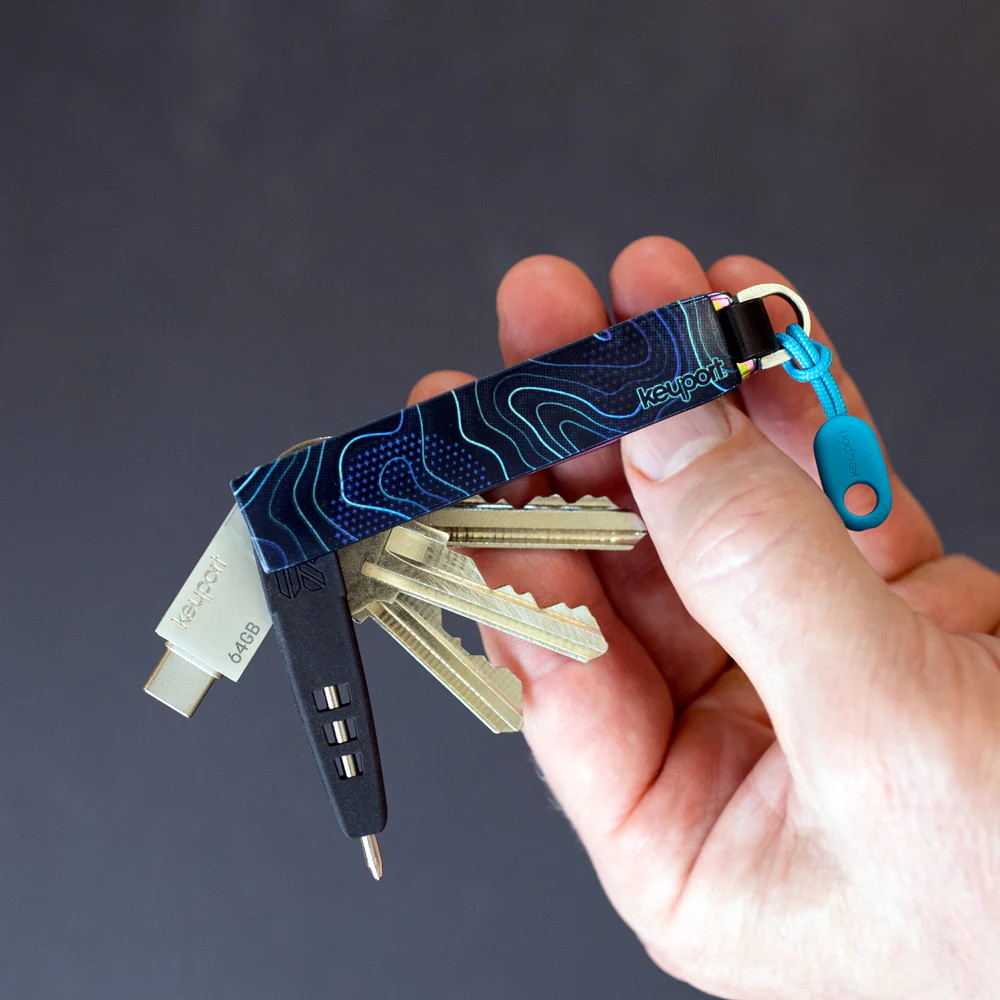

Keyport Faceplate Scales are removable side plates that allow you to customize your Keyport Pivot, Keyport Slide, or Anywhere Tools Bundles by Keyport. Similar to knife scales, Faceplate Scales add both function and personalization to Keyport's modular key organizers, key holders, and keychain multi-tools.
Why Choose a Faceplate Scale?
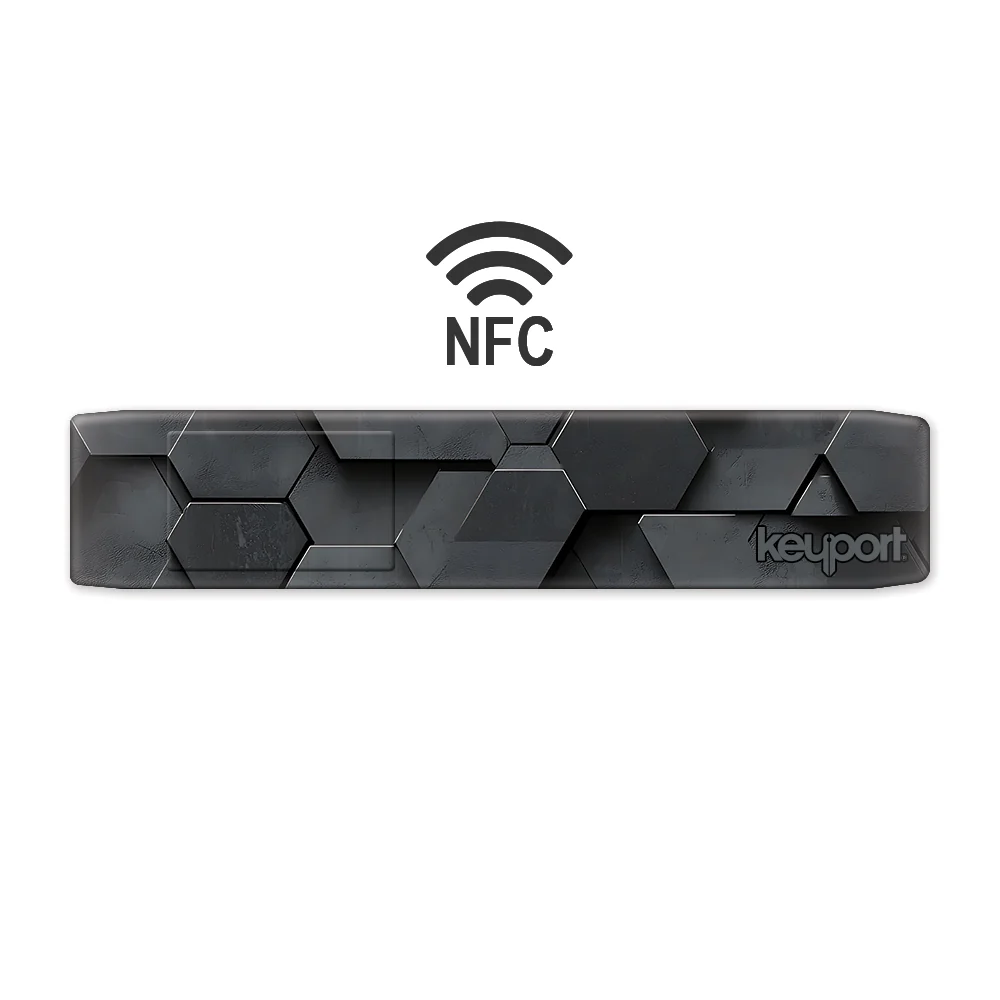
The Willys MB Jeep Faceplate Scale features a durable stainless spring steel plate staked to a polycarbonate outer shell. The graphics are hardened on the outside of the PC shell with a special ink that is baked on with ultraviolet light and highly resistant to wear and tear. The UV-hardened ink preserves the authentic field weathering, hand-chalked markings, and unit insignia of the original vehicle, even with daily carry. The fastener-free design makes snapping on a new Faceplate a literal snap, and removing them is very easy with the help of a paper clip, pen tip, or Module Removal Tool (MRT). So, you can switch them up whenever you like.
Note: Each Faceplate Scale is individually sold.
Key Features
- Precision Fit - Designed to seamlessly attach to the Keyport Pivot, Anywhere Pocket Clip (as a money clip), NEBA Module, MOCA2 Module, Keyport Slide 3.0, or the Keyport Slide 4.0.
- Ergonomic & Lightweight – Adds style without bulk, maintaining a sleek, compact profile.
- No-Fastener Attachment – Securely clicks on/off with no screws or extra hardware.
- Built to Last – Features stainless steel backing and UV-hardened graphics for maximum durability.
- Multi-Use Functionality – Works as a money clip when paired with the Anywhere Pocket Clip.
Specifications
- Materials: Stainless Steel & Polycarbonate
- Graphics: UV Hardened Ink
- Dimensions: L: 2.865" H: 0.596" T: 0.105"
- Weight: 0.18 oz.
Frequently Asked Questions
What is a Faceplate Scale?
Keyport Faceplate Scales are removable side plates for customizing your Keyport Pivot, Slide, and Anywhere Tools. They work like knife scales, offering both function and flair.
Are Faceplate Scales compatible with all Keyport products?
Faceplates are compatible with the Keyport Pivot, Slide 3.0, Slide 4.0, NEBA Module, MOCA2 Module, and the Anywhere Pocket Clip (where it functions as a money clip).
How do I remove or replace a Faceplate Scale?
A small tool is required to remove a Faceplate, either a paperclip, pen tip, or our recommended Keyport Module Removal Tool (MRT). To remove, simply depress the center dimple, slide the Faceplate backward, and lift it off.
The MRT is especially helpful for both Pivot setup and quick removal of modules or Faceplates.
▶️ Watch How-To Video at 1:25
Are Faceplates durable?
Absolutely. Each Faceplate Scale features a stainless steel backing and UV-hardened ink for long-lasting, scratch-resistant performance.
Can I buy more than one to change them up?
Yes. Our modular design means you can collect and swap Faceplates anytime to match your style, mood, or mission.
Description
Carry the Workhorse
In 1940, the U.S. Army issued a specification most manufacturers thought was impossible: a four-wheel-drive reconnaissance vehicle under 1,300 pounds, with a 660-pound payload capacity, and a working prototype due in 49 days. Of 135 companies approached, two responded. Willys-Overland delivered the MB. By the end of the war, more than 647,000 had rolled off the line. Generals rode in them. Medics loaded stretchers across them. Signal corps ran wire from them. Ernie Pyle wrote from North Africa: "I don't think we could continue the war without the jeep. It does everything. It goes everywhere. It's as faithful as a dog, as strong as a mule, and as agile as a goat."
Eisenhower listed it among the handful of pieces of equipment senior officers regarded as most vital to victory in Africa and Europe. He noted the irony: none of them were designed for combat.
This faceplate recreates a section of a Willys MB attached to the 101st Airborne Division, Normandy, June 1944. The broken-circle invasion star marks an Allied vehicle in the D-Day theater. The hand-chalked "NORMANDY" and "6 JUNE 44" are the kind of markings soldiers scrawled on their vehicles every day. The Screaming Eagle insignia of the 101st and the division motto, "Rendezvous with Destiny," mark the unit. The small wire-cutter bar silhouette references the vertical bars welded to jeep bumpers to cut piano wire the Germans strung across roads at neck height. The mud is from the Norman bocage. The paint is worn to bare metal at every stress point. This vehicle has been working since Utah Beach and hasn't stopped.
No single jeep is famous. That's the point. The most important vehicle of the century was the one nobody noticed.
Part of the Military Skins series. Each faceplate simulates the exterior surface of an iconic military vehicle, reduced to fit your Keyport.
About the Willys MB Jeep
The Willys MB was the original Jeep. Designed in 1940 to meet U.S. Army specifications that 133 of 135 manufacturers refused even to bid on, the MB was a 60-horsepower, four-wheel-drive, 2,300-pound vehicle that could go almost anywhere and carry almost anything. American Bantam designed the first prototype. Ford had the production capacity. But Willys-Overland's "Go Devil" engine was decisive, and the Army standardized on the Willys design, licensing Ford to build a nearly identical version as the GPW. Parts were fully interchangeable between Willys and Ford jeeps. Between 1941 and 1945, Willys produced 362,841 MBs and Ford produced 280,448 GPWs.
The MB served in every theater of the war. It hauled wounded under fire, carried command staff across continents, towed antitank guns, and ran wire for the Signal Corps. It fit inside a C-47 and could be loaded into a glider for airborne assault. It carried twice what it was designed for and kept going. A Marine MB on Guadalcanal was struck by Japanese shrapnel and awarded the Purple Heart. General George Marshall called the jeep "America's greatest contribution to modern warfare."
After the war, soldiers came home wanting one. Willys-Overland began selling the CJ — Civilian Jeep — in 1945. Every Wrangler, Cherokee, and Gladiator on the road today traces directly to the 60-horsepower box on wheels that Willys built in 49 days.
What is a Faceplate Scale?
Keyport Faceplate Scales are removable side plates that allow you to customize your Keyport Pivot, Keyport Slide, or Anywhere Tools Bundles by Keyport. Similar to knife scales, Faceplate Scales add both function and personalization to Keyport's modular key organizers, key holders, and keychain multi-tools.
Why Choose a Faceplate Scale?
The Willys MB Jeep Faceplate Scale features a durable stainless spring steel plate staked to a polycarbonate outer shell. The graphics are hardened on the outside of the PC shell with a special ink that is baked on with ultraviolet light and highly resistant to wear and tear. The UV-hardened ink preserves the authentic field weathering, hand-chalked markings, and unit insignia of the original vehicle, even with daily carry. The fastener-free design makes snapping on a new Faceplate a literal snap, and removing them is very easy with the help of a paper clip, pen tip, or Module Removal Tool (MRT). So, you can switch them up whenever you like.
Note: Each Faceplate Scale is individually sold.
Key Features
- Precision Fit - Designed to seamlessly attach to the Keyport Pivot, Anywhere Pocket Clip (as a money clip), NEBA Module, MOCA2 Module, Keyport Slide 3.0, or the Keyport Slide 4.0.
- Ergonomic & Lightweight – Adds style without bulk, maintaining a sleek, compact profile.
- No-Fastener Attachment – Securely clicks on/off with no screws or extra hardware.
- Built to Last – Features stainless steel backing and UV-hardened graphics for maximum durability.
- Multi-Use Functionality – Works as a money clip when paired with the Anywhere Pocket Clip.
Specifications
- Materials: Stainless Steel & Polycarbonate
- Graphics: UV Hardened Ink
- Dimensions: L: 2.865" H: 0.596" T: 0.105"
- Weight: 0.18 oz.
Frequently Asked Questions
What is a Faceplate Scale?
Keyport Faceplate Scales are removable side plates for customizing your Keyport Pivot, Slide, and Anywhere Tools. They work like knife scales, offering both function and flair.
Are Faceplate Scales compatible with all Keyport products?
Faceplates are compatible with the Keyport Pivot, Slide 3.0, Slide 4.0, NEBA Module, MOCA2 Module, and the Anywhere Pocket Clip (where it functions as a money clip).
How do I remove or replace a Faceplate Scale?
A small tool is required to remove a Faceplate, either a paperclip, pen tip, or our recommended Keyport Module Removal Tool (MRT). To remove, simply depress the center dimple, slide the Faceplate backward, and lift it off.
The MRT is especially helpful for both Pivot setup and quick removal of modules or Faceplates.
▶️ Watch How-To Video at 1:25
Are Faceplates durable?
Absolutely. Each Faceplate Scale features a stainless steel backing and UV-hardened ink for long-lasting, scratch-resistant performance.
Can I buy more than one to change them up?
Yes. Our modular design means you can collect and swap Faceplates anytime to match your style, mood, or mission.