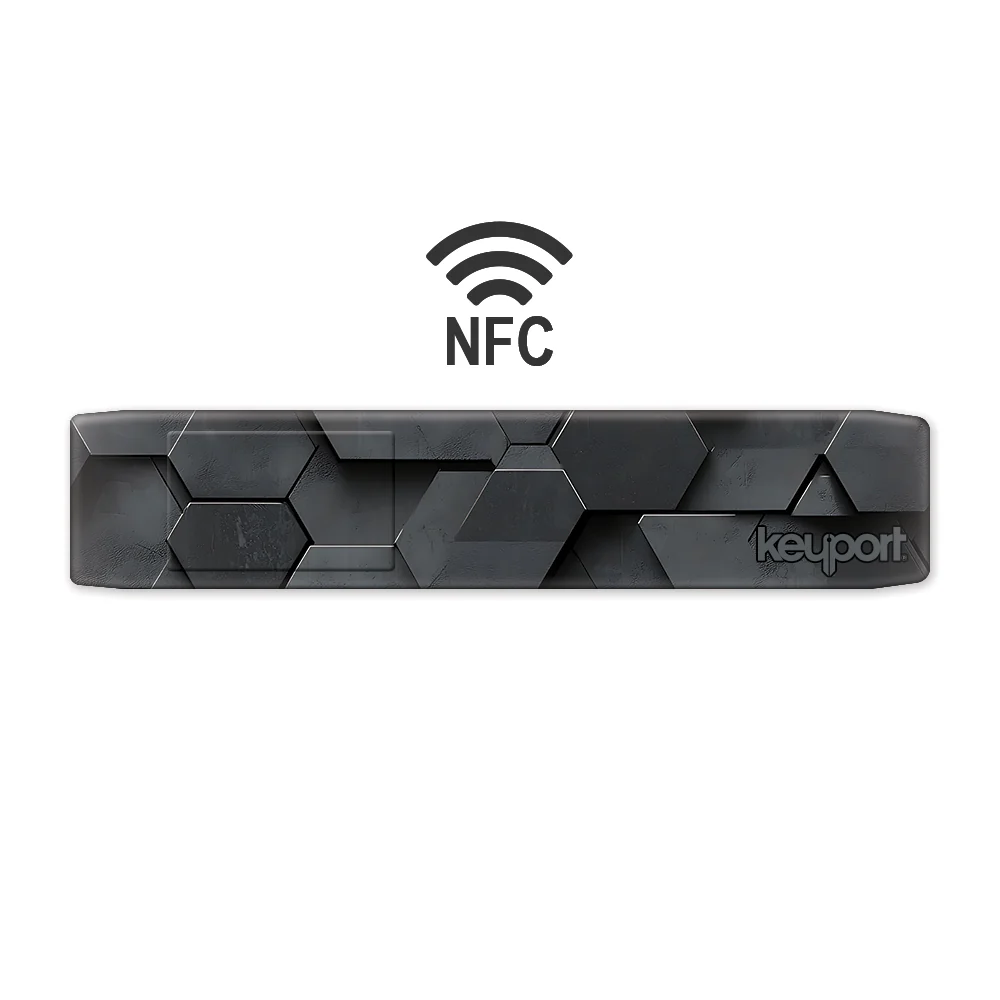
M4 Sherman "Thunderbolt VII" Military Skin Faceplate
Carry the Thunderbolt
By the end of the war in Europe, Lt. Col. Creighton Abrams had ridden seven Sherman tanks into combat. Each one was painted with the same name: Thunderbolt. As one was retired to damage, breakdown, or upgrade, he took the name with him to the next. Thunderbolt VII was the seventh. The one that ended the war.
Abrams commanded the 37th Tank Battalion of the 4th Armored Division, the armored spearhead of Patton's Third Army from Normandy to Czechoslovakia. He led from the turret, cigar clamped in his teeth, in the lead tank of every column. At the Battle of the Bulge in December 1944, his battalion punched through German lines to relieve the 101st Airborne at Bastogne. Patton said of him: "I'm supposed to be the best tank commander in the Army, but I have one peer—Abe Abrams. He's the world champion." The Army later named its next-generation main battle tank after him. The M1 Abrams is still in service today.
This faceplate recreates a section of Thunderbolt VII's hull armor: cast steel with heavy weld beads, the partial invasion star with its field-applied overspray edges, and the hand-painted name in brush lettering that looks exactly like what a tank crew would paint in a field in Germany. The kill tallies below the name mark German armor destroyed. The bumper code reads 4A-37-HQ: 4th Armored Division, 37th Tank Battalion, Headquarters. Mud from the European countryside clings to the lower edge. Paint is chipped to bare steel at the rivets.
Thunderbolt VII was an M4A3E8 — the late-war Sherman variant nicknamed the "Easy Eight" for its E8 designation and Horizontal Volute Spring Suspension. Better gun, smoother ride, more armor. If the silhouette looks familiar, the M4A3E8 is also the Sherman Brad Pitt drove in Fury. Same tank, different commander.
Seven tanks. One name. The man they named the Abrams after.
Part of the Military Skins series. Each faceplate simulates the exterior surface of an iconic military vehicle, reduced to fit your Keyport.
About the M4 Sherman
The M4 Sherman was the workhorse of the U.S. Army in World War II. More than 49,000 were built across 11 plants between 1942 and 1945, and the Sherman saw combat in every theater — Europe, the Pacific, North Africa, Italy, and the Soviet Union under Lend-Lease. It wasn't the best tank on any individual axis. German Tigers and Panthers had thicker armor and more powerful guns. But the Sherman was reliable, fast, easy to manufacture, easy to repair, and produced in volumes the Germans couldn't match. The doctrine was numbers. Allied armor commanders coordinated platoons of four to five Shermans to flank a single Tiger, using maneuver and rate of fire to defeat a heavier opponent. Casualties were high. Tank crews knew it. They named their tanks anyway.
The M4A3E8 "Easy Eight," produced starting in late 1944, was the upgraded late-war variant: a 76mm high-velocity gun that could penetrate German armor, Horizontal Volute Spring Suspension for a smoother ride and better off-road performance, and additional armor on the hull and turret. By war's end, the Easy Eight was the most capable Sherman in the field. Thunderbolt VII was one of them.
After the war, the U.S. Army named its next-generation main battle tank after the lieutenant colonel who commanded seven of these Shermans across Europe. The M1 Abrams is the M4's direct doctrinal descendant: a U.S. main battle tank built to win by combining good-enough armor with overwhelming volume, mobility, and crew quality. The tank carries the man's name into the next century.
What is a Faceplate Scale?
Keyport Faceplate Scales are removable side plates that allow you to customize your Keyport Pivot, Keyport Slide, or Anywhere Tools Bundles by Keyport. Similar to knife scales, Faceplate Scales add both function and personalization to Keyport's modular key organizers, key holders, and keychain multi-tools.
Why Choose a Faceplate Scale?
The M4 Sherman "Thunderbolt VII" Faceplate Scale features a durable stainless spring steel plate staked to a polycarbonate outer shell. The graphics are hardened on the outside of the PC shell with a special ink that is baked on with ultraviolet light and highly resistant to wear and tear. The UV-hardened ink preserves the authentic field weathering, brush-painted name, and unit markings of the original vehicle, even with daily carry. The fastener-free design makes snapping on a new Faceplate a literal snap, and removing them is very easy with the help of a paper clip, pen tip, or Module Removal Tool (MRT). So, you can switch them up whenever you like.
Note: Each Faceplate Scale is individually sold.
Key Features
- Precision Fit - Designed to seamlessly attach to the Keyport Pivot, Anywhere Pocket Clip (as a money clip), NEBA Module, MOCA2 Module, Keyport Slide 3.0, or the Keyport Slide 4.0.
- Ergonomic & Lightweight – Adds style without bulk, maintaining a sleek, compact profile.
- No-Fastener Attachment – Securely clicks on/off with no screws or extra hardware.
- Built to Last – Features stainless steel backing and UV-hardened graphics for maximum durability.
- Multi-Use Functionality – Works as a money clip when paired with the Anywhere Pocket Clip.
Specifications
- Materials: Stainless Steel & Polycarbonate
- Graphics: UV Hardened Ink
- Dimensions: L: 2.865" H: 0.596" T: 0.105"
- Weight: 0.18 oz.
Frequently Asked Questions
What is a Faceplate Scale?
Keyport Faceplate Scales are removable side plates for customizing your Keyport Pivot, Slide, and Anywhere Tools. They work like knife scales, offering both function and flair.
Are Faceplate Scales compatible with all Keyport products?
Faceplates are compatible with the Keyport Pivot, Slide 3.0, Slide 4.0, NEBA Module, MOCA2 Module, and the Anywhere Pocket Clip (where it functions as a money clip).
How do I remove or replace a Faceplate Scale?
A small tool is required to remove a Faceplate, either a paperclip, pen tip, or our recommended Keyport Module Removal Tool (MRT). To remove, simply depress the center dimple, slide the Faceplate backward, and lift it off.
The MRT is especially helpful for both Pivot setup and quick removal of modules or Faceplates.
▶️ Watch How-To Video at 1:25
Are Faceplates durable?
Absolutely. Each Faceplate Scale features a stainless steel backing and UV-hardened ink for long-lasting, scratch-resistant performance.
Can I buy more than one to change them up?
Yes. Our modular design means you can collect and swap Faceplates anytime to match your style, mood, or mission.
Description
Carry the Thunderbolt
By the end of the war in Europe, Lt. Col. Creighton Abrams had ridden seven Sherman tanks into combat. Each one was painted with the same name: Thunderbolt. As one was retired to damage, breakdown, or upgrade, he took the name with him to the next. Thunderbolt VII was the seventh. The one that ended the war.
Abrams commanded the 37th Tank Battalion of the 4th Armored Division, the armored spearhead of Patton's Third Army from Normandy to Czechoslovakia. He led from the turret, cigar clamped in his teeth, in the lead tank of every column. At the Battle of the Bulge in December 1944, his battalion punched through German lines to relieve the 101st Airborne at Bastogne. Patton said of him: "I'm supposed to be the best tank commander in the Army, but I have one peer—Abe Abrams. He's the world champion." The Army later named its next-generation main battle tank after him. The M1 Abrams is still in service today.
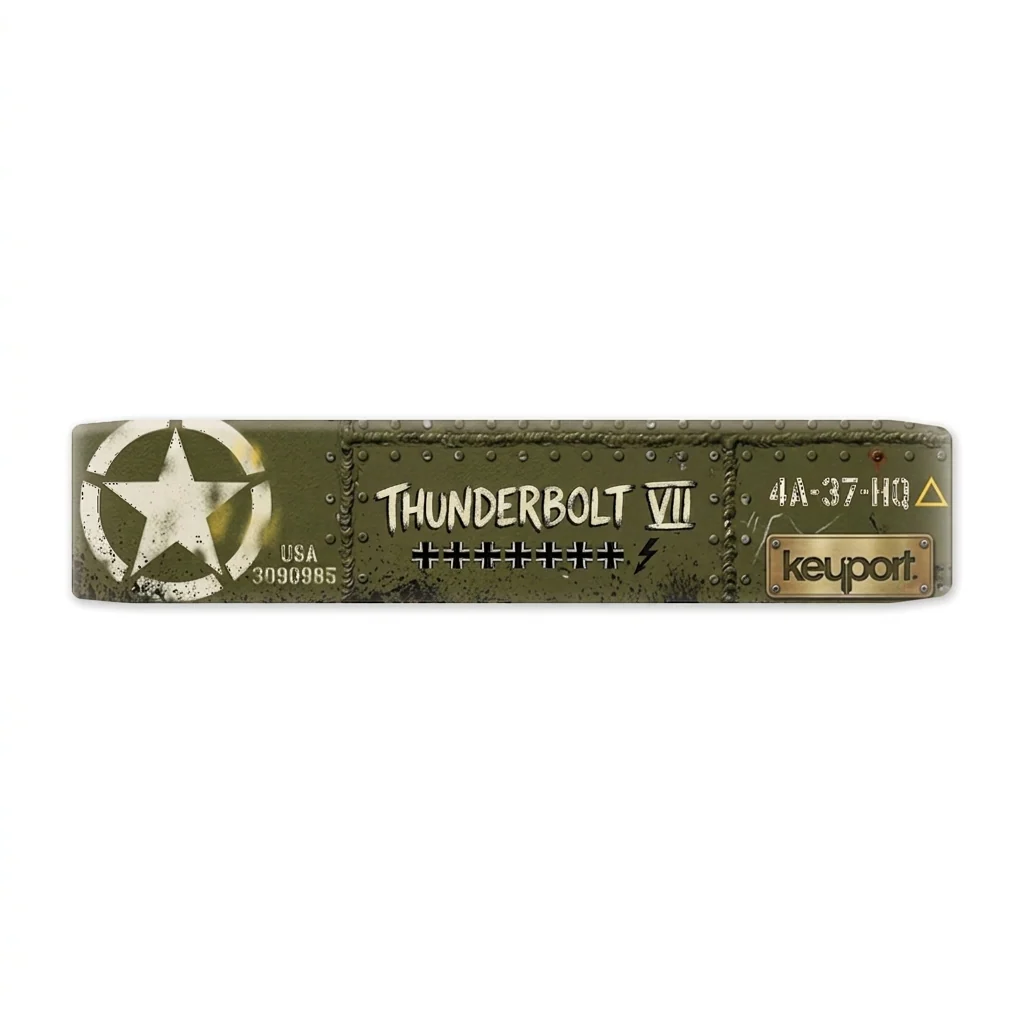
This faceplate recreates a section of Thunderbolt VII's hull armor: cast steel with heavy weld beads, the partial invasion star with its field-applied overspray edges, and the hand-painted name in brush lettering that looks exactly like what a tank crew would paint in a field in Germany. The kill tallies below the name mark German armor destroyed. The bumper code reads 4A-37-HQ: 4th Armored Division, 37th Tank Battalion, Headquarters. Mud from the European countryside clings to the lower edge. Paint is chipped to bare steel at the rivets.
Thunderbolt VII was an M4A3E8 — the late-war Sherman variant nicknamed the "Easy Eight" for its E8 designation and Horizontal Volute Spring Suspension. Better gun, smoother ride, more armor. If the silhouette looks familiar, the M4A3E8 is also the Sherman Brad Pitt drove in Fury. Same tank, different commander.
Seven tanks. One name. The man they named the Abrams after.
Part of the Military Skins series. Each faceplate simulates the exterior surface of an iconic military vehicle, reduced to fit your Keyport.
About the M4 Sherman
The M4 Sherman was the workhorse of the U.S. Army in World War II. More than 49,000 were built across 11 plants between 1942 and 1945, and the Sherman saw combat in every theater — Europe, the Pacific, North Africa, Italy, and the Soviet Union under Lend-Lease. It wasn't the best tank on any individual axis. German Tigers and Panthers had thicker armor and more powerful guns. But the Sherman was reliable, fast, easy to manufacture, easy to repair, and produced in volumes the Germans couldn't match. The doctrine was numbers. Allied armor commanders coordinated platoons of four to five Shermans to flank a single Tiger, using maneuver and rate of fire to defeat a heavier opponent. Casualties were high. Tank crews knew it. They named their tanks anyway.
The M4A3E8 "Easy Eight," produced starting in late 1944, was the upgraded late-war variant: a 76mm high-velocity gun that could penetrate German armor, Horizontal Volute Spring Suspension for a smoother ride and better off-road performance, and additional armor on the hull and turret. By war's end, the Easy Eight was the most capable Sherman in the field. Thunderbolt VII was one of them.
After the war, the U.S. Army named its next-generation main battle tank after the lieutenant colonel who commanded seven of these Shermans across Europe. The M1 Abrams is the M4's direct doctrinal descendant: a U.S. main battle tank built to win by combining good-enough armor with overwhelming volume, mobility, and crew quality. The tank carries the man's name into the next century.
What is a Faceplate Scale?
Keyport Faceplate Scales are removable side plates that allow you to customize your Keyport Pivot, Keyport Slide, or Anywhere Tools Bundles by Keyport. Similar to knife scales, Faceplate Scales add both function and personalization to Keyport's modular key organizers, key holders, and keychain multi-tools.
Why Choose a Faceplate Scale?
The M4 Sherman "Thunderbolt VII" Faceplate Scale features a durable stainless spring steel plate staked to a polycarbonate outer shell. The graphics are hardened on the outside of the PC shell with a special ink that is baked on with ultraviolet light and highly resistant to wear and tear. The UV-hardened ink preserves the authentic field weathering, brush-painted name, and unit markings of the original vehicle, even with daily carry. The fastener-free design makes snapping on a new Faceplate a literal snap, and removing them is very easy with the help of a paper clip, pen tip, or Module Removal Tool (MRT). So, you can switch them up whenever you like.
Note: Each Faceplate Scale is individually sold.
Key Features
- Precision Fit - Designed to seamlessly attach to the Keyport Pivot, Anywhere Pocket Clip (as a money clip), NEBA Module, MOCA2 Module, Keyport Slide 3.0, or the Keyport Slide 4.0.
- Ergonomic & Lightweight – Adds style without bulk, maintaining a sleek, compact profile.
- No-Fastener Attachment – Securely clicks on/off with no screws or extra hardware.
- Built to Last – Features stainless steel backing and UV-hardened graphics for maximum durability.
- Multi-Use Functionality – Works as a money clip when paired with the Anywhere Pocket Clip.
Specifications
- Materials: Stainless Steel & Polycarbonate
- Graphics: UV Hardened Ink
- Dimensions: L: 2.865" H: 0.596" T: 0.105"
- Weight: 0.18 oz.
Frequently Asked Questions
What is a Faceplate Scale?
Keyport Faceplate Scales are removable side plates for customizing your Keyport Pivot, Slide, and Anywhere Tools. They work like knife scales, offering both function and flair.
Are Faceplate Scales compatible with all Keyport products?
Faceplates are compatible with the Keyport Pivot, Slide 3.0, Slide 4.0, NEBA Module, MOCA2 Module, and the Anywhere Pocket Clip (where it functions as a money clip).
How do I remove or replace a Faceplate Scale?
A small tool is required to remove a Faceplate, either a paperclip, pen tip, or our recommended Keyport Module Removal Tool (MRT). To remove, simply depress the center dimple, slide the Faceplate backward, and lift it off.
The MRT is especially helpful for both Pivot setup and quick removal of modules or Faceplates.
▶️ Watch How-To Video at 1:25
Are Faceplates durable?
Absolutely. Each Faceplate Scale features a stainless steel backing and UV-hardened ink for long-lasting, scratch-resistant performance.
Can I buy more than one to change them up?
Yes. Our modular design means you can collect and swap Faceplates anytime to match your style, mood, or mission.